Imagine two homeowners in Chula Vista looking for a roofer.
The first opens Google, types “roof repair near me,” and ends up with five tabs open — scanning reviews, comparing estimates, and bouncing between a couple of companies.
The second asks ChatGPT which roofers serve their neighborhood, have strong reviews, and specialize in tile roofs. ChatGPT narrows the options and explains why each one might fit.
When the second homeowner finally visits a roofing company’s website, they are not beginning their research. They may be much further along in the decision process.
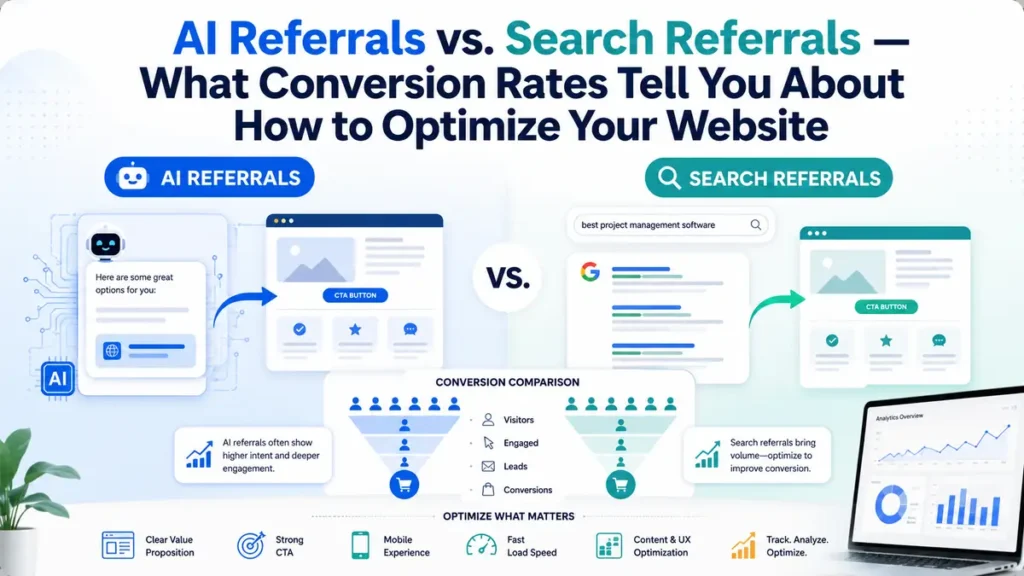
That difference helps explain why visitors referred by AI tools appear to convert at a higher rate — even though AI still sends only a small fraction of website traffic.
The takeaway: AI referral traffic appears to be higher intent, lower volume, and growing quickly. It should influence your website strategy — but it should not replace your SEO strategy.
What the best-supported data actually shows
The most reliable dataset we have comes from Visibility Labs, which analyzed a full year of 2025 Google Analytics data across 94 seven- and eight-figure ecommerce brands (Visibility Labs, 2025). Visitors arriving from ChatGPT converted at 1.81 percent, compared with 1.39 percent for non-branded organic search. That’s a 31 percent higher conversion rate, from real GA4 data at meaningful scale.
A 31 percent conversion advantage sounds like a clean headline — but read the fine print. That research covered ecommerce stores, not plumbers, attorneys, dentists, roofers, or other local service businesses. If you run a local service business, treat the 31 percent as evidence of stronger intent, not as a guaranteed benchmark for your own industry.
You may have seen much bigger claims. Semrush’s 2025 study of more than 500 topics concluded that AI search visitors are roughly 4.4 times as valuable as traditional organic visitors, though the methodology was only partly disclosed, so treat that figure as directional rather than gospel ( Semrush, 2025). And Seer Interactive published a case where ChatGPT referrals converted at 15.9 percent against 1.76 percent for Google organic — which sounds incredible until you notice it was a single website, and those referrals were a tiny sliver of its traffic (Seer Interactive). One site is a story, not a benchmark.
So the most credible large-scale benchmark I found showed a 31 percent conversion advantage for ChatGPT referrals — but it came from ecommerce sites. Local service businesses should treat that as evidence of stronger intent, not as a guaranteed conversion benchmark for their own industry.
Higher conversion did not mean dramatically higher revenue. The same Visibility Labs data found that ChatGPT visitors had a 14.3 percent lower average order value, leaving revenue per session only about 10.3 percent higher than organic search. And because the channel was so small, ChatGPT generated just 1.48 percent as much revenue as non-branded organic search during the study period. In other words: better visitors, but nowhere near enough of them to replace search.
Why AI-referred visitors may arrive warmer
The reason is simple once you see it. Someone who clicks through from ChatGPT has already done much of their research inside the conversation. The AI compared the options, answered their follow-up questions, and pointed to you. By the time they land on your site, they may be much further along in the decision process. A Google searcher, by contrast, is often still comparing tabs.
| Traditional search visitor | AI-referred visitor |
|---|---|
| Often beginning comparison | Often arriving after comparison |
| May open several websites | May visit only a few recommendations |
| Usually credited accurately in analytics | Frequently undercounted |
| High volume | Low but growing volume |
The volume problem — and the attribution problem
Before you rearrange your marketing around AI, look at the volume side. Previsible’s 2026 AI Traffic Report tracked 166 GA4 properties from November 2024 through May 2026 and found that AI referrals grew from 0.4 percent to 1.71 percent of sessions for small and mid-size businesses (Previsible, 2026). That’s more than a fourfold increase in share, and total LLM-referred sessions across the panel grew nearly tenfold. It’s also still less than 2 percent of traffic.
In practice, ChatGPT currently accounts for most trackable AI referral traffic — Previsible found it made up 92.4 percent of all trackable LLM referral traffic. So when someone sells you “AI search optimization,” what they largely mean is ChatGPT visibility.
These numbers measure trackable referrals, not every customer influenced by AI. GA4 can identify someone who clicks directly from ChatGPT; it usually cannot identify someone who sees a recommendation in ChatGPT, searches the business name on Google, and then visits through branded search. The Visibility Labs researchers specifically noted this attribution problem. If ChatGPT recommends a company and the user later searches its name on Google, Analytics will usually credit Google — not ChatGPT. AI’s influence may therefore be larger than the referral reports suggest.
Meanwhile, traditional search clicks are shrinking
Here’s the half of the story that changes the math even if you never get a single ChatGPT referral: the clicks you were used to getting from Google are getting scarcer.
Pew Research Center tracked the real browsing behavior of 900 U.S. adults across nearly 69,000 searches (Pew Research Center, 2025). When Google showed an AI Overview at the top of the results, users clicked a traditional result in only 8 percent of visits, versus 15 percent when no AI summary appeared. The links cited inside those AI Overviews were clicked about 1 percent of the time. Other large studies put the click-through reduction for top-ranking pages anywhere from 38 to 58 percent when an AI Overview is present, so the exact damage varies, but the direction doesn’t.
Put both halves together and you get the real headline: your website is receiving fewer visits, and each visit is worth more. A leaky website — one that loads slowly, confuses people, or buries the phone number — costs you more today than it did two years ago, because there’s no longer a flood of traffic to hide the leaks.
What local businesses should do
Job 1: Convert the visitors you already get
This is the highest-return work available to most small businesses right now, and it has nothing to do with AI. A decent local service business landing page converts somewhere in the low- to high-single-digit range — Unbounce reports a 6.1 percent median for commercial and professional service landing pages, though conversion varies substantially by industry, urgency, and conversion event, so don’t treat any single number as a universal target (Unbounce). If yours is below that, there’s real headroom, and the fixes are rarely exotic. Rewrite the page in plain language a stressed customer can skim. Fix the mobile experience, since that’s where most of your visitors are. And put your proof on the page: BrightLocal’s 2026 consumer survey of 1,002 U.S. consumers found that 68 percent of people require a 4-star-plus rating before they’ll consider a local business, and nearly half won’t use one with fewer than 20 reviews (BrightLocal, 2026). Those reviews shouldn’t live only on Google. Embed them where the buying decision happens, on your site.
If you’re not sure where your site leaks, a proper SEO audit will find it faster than guessing.
Job 2: Become the business AI tools recommend
Since AI referrals convert better, the question becomes how to earn more of them. The good news is that the answer looks a lot like doing the fundamentals well, not learning a bag of tricks.
Start with crawlability and completeness. When Profound analyzed more than 200,000 ChatGPT shopping prompts in July 2026, it found that most of the product and business information ChatGPT showed came from crawling the open web, not from any special feed (Profound, 2026). I could not independently verify the exact percentage cited in some write-ups, so treat the underlying point — that complete, crawlable pages matter — as the takeaway. If your services, prices, and service area aren’t written out on real, crawlable pages, AI tools have nothing to recommend.
Then strengthen the review sources AI systems rely upon. In July 2026, Yelp licensed its reviews and business data to OpenAI, which means your Yelp reputation now surfaces directly inside ChatGPT’s local answers (Axios, 2026). Between that and Google Business Profile, which has become one of the most-cited sources inside Google’s own AI results for local queries, your review profile is no longer just social proof. It’s the raw material AI systems use to decide who to recommend. This is exactly the territory covered by answer engine optimization, and it pairs naturally with the local SEO work you may already be doing.
Finally, write direct answers. Structure your pages so the important passages — what you do, where you do it, what it costs — still make sense when an AI quotes them out of context.
What this looks like in practice. Vague website copy:
“We provide high-quality solutions customized to meet your unique needs.”
Useful, AI-readable copy (from our Chula Vista roofer example):
“Coastline Roofing repairs and replaces tile, shingle, and flat roofs throughout Chula Vista, Eastlake, Bonita, and South San Diego. Residential inspections are available Monday through Saturday.”
That small example may teach more than several explanatory paragraphs.
Job 3: Start measuring now
Open Google Analytics and set up tracking for referrals from chatgpt.com and the other AI platforms this week, even if the numbers look tiny. The businesses that can see their AI referral traffic today will know exactly when the channel starts to matter for them, and they’ll have a baseline to prove it. The ones that can’t will be guessing. Remember the attribution caveat above: the number you see is a floor, not a ceiling.
What not to do
Don’t chase the 9x-to-23x multiplier headlines into a strategy pivot; the realistic lift is about 31 percent on roughly 2 percent of traffic. Don’t pour money into generic how-to blog content, either. Publisher data from 2026 shows how-to content is the most heavily cannibalized by AI answers, with some categories losing more than half their Google referrals. Service pages, pricing information, local proof, and first-hand expertise hold their value far better. And don’t block AI crawlers from your site. For most lead-generation businesses, remaining accessible to legitimate AI crawlers is the practical choice.
Do not abandon SEO. Improve conversion, strengthen your review profiles, and make your business easier for both search engines and AI systems to understand.
What to do this week
- Check whether your most important service, location, pricing, and availability information appears in crawlable text.
- Put recent customer proof near your main call to action.
- Test every form, phone button, and booking link on a real phone.
- Begin tracking referrals from ChatGPT and other AI platforms.
- Ask several AI tools how they describe your business and note any missing or incorrect information.
The bottom line
The web is shift toward a trust game. AI referral traffic converts better because the recommendation happens before the click, which means the way you win is by being recommendable: complete and crawlable pages, a genuine review base on Google and Yelp, a tight Google Business Profile, and a website that converts whoever lands on it. Fewer visitors, each worth more, favors businesses whose online presence is actually in order. That’s not a threat. For a well-run local business, it’s an advantage.
Want to know whether AI tools can find, understand, and confidently recommend your business? A Villegas Digital website and SEO audit shows what those systems can see, where your website may be losing leads, and which improvements should come first.
Related services: SEO audits · Answer engine optimization · Local SEO & Google Business Profile
Keep reading: What Eastlake’s Business Climate Means for Your Website
Sources
- Visibility Labs (2025) — year-long GA4 study of 94 ecommerce brands; ChatGPT vs. non-branded organic conversion, AOV, and revenue-per-session.
- Semrush (2025) — study of 500+ topics on relative value of AI search vs. organic visitors.
- Seer Interactive — published case study of ChatGPT vs. Google organic conversion for a single site.
- Previsible (2026) — AI Traffic Report, 166 GA4 properties, Nov 2024–May 2026.
- Pew Research Center (2025) — browsing behavior across ~69,000 searches; AI Overviews and click rates.
- BrightLocal (2026) — Local Consumer Review Survey, 1,002 U.S. consumers.
- Profound (2026) — analysis of 200,000+ ChatGPT shopping prompts (July 2026).
- Axios (2026) — reporting on the Yelp–OpenAI data licensing agreement.
- Unbounce — benchmark data on service landing-page conversion medians.